How Strong Is a Cheetah Bite Force? A Complete Breakdown of Power, Pain, and Predatory Efficiency
When people think of cheetahs, speed is the first thing that comes to mind. Known as the fastest land animal on Earth, the cheetah dominates open plains with unmatched acceleration. But one question often overlooked is: how strong is a cheetah’s bite force, and how painful would it be?
In this in-depth guide, we will explore the bite force of a cheetah, how it compares to other predators, the biological mechanics behind it, and what that bite actually feels like in terms of pain. We will also look at how evolution shaped the cheetah’s jaw strength and why it differs from other big cats.
Understanding Bite Force: What Does It Mean?
Before diving into cheetahs specifically, it is important to understand what bite force actually is.
Bite force is typically measured in PSI (pounds per square inch). This unit reflects the amount of pressure an animal can exert with its jaws. The higher the PSI, the stronger the bite.
Key factors influencing bite force include:
- Skull structure
- Jaw muscle size
- Tooth shape and alignment
- Hunting style and prey type
Different predators have evolved different bite strengths depending on their ecological role.
What Is the Bite Force of a Cheetah?
A cheetah’s bite force is estimated to be around 400 PSI.
Compared to other big cats, this is relatively modest:
- Lion: 650 PSI
- Tiger: 1,050 PSI
- Jaguar: 1,500 PSI
- Leopard: 300–400 PSI
So where does the cheetah stand? Right in the lower-middle range among big cats.
Why Is a Cheetah’s Bite Force Relatively Weak?
At first glance, you might assume that a powerful predator would have a powerful bite. However, the cheetah evolved differently.
- Built for Speed, Not Strength
Cheetahs have:
- Lightweight skeletons
- Smaller skulls
- Reduced jaw muscle mass
These adaptations allow them to:
- Reach speeds of up to 100 km/h (62 mph)
- Accelerate faster than most vehicles
But there is a trade-off: less muscle mass in the jaw = lower bite force.
- Hunting Strategy Matters
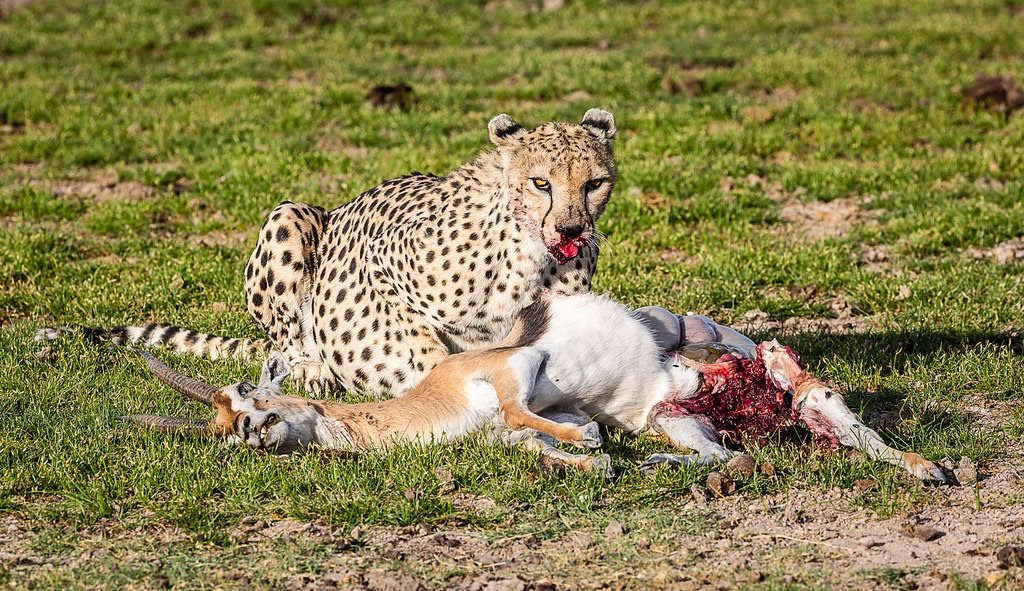
Unlike lions or jaguars, cheetahs don’t rely on crushing bites.
Instead, they:
- Sprint to chase prey
- Trip the animal using their paws
- Deliver a precise suffocating bite to the throat
This means they don’t need massive bite pressure. Precision matters more than power.
- Skull and Teeth Design
Cheetahs have:
- Narrow skulls
- Smaller canines compared to other big cats
- Teeth designed for slicing rather than crushing
This anatomy supports quick kills rather than brute-force attacks.
How Painful Is a Cheetah Bite?
Now to the core question: what would it feel like?
Pain Level Breakdown
A cheetah bite at 400 PSI would be:
- Strong enough to puncture skin easily
- Capable of crushing smaller bones
- Extremely painful due to sharp canine penetration
However, compared to larger predators, it’s less destructive.
Pain Comparison (Human Perspective)
Let us contextualize the pain:
- Human bite: 120–160 PSI
- Large dog (e.g., German Shepherd): 230–300 PSI
- Cheetah: 400 PSI
This means:
- A cheetah bite is significantly stronger than a human bite
- Stronger than most domestic dogs
- But not as devastating as apex predators
What Happens During a Bite?
If a cheetah were to bite:
- Initial penetration – sharp canines pierce the skin
- Pressure application – jaw clamps down with force
- Tissue compression – muscles and possibly bones are compressed
- Pain response – intense, immediate, and potentially incapacitating
The pain would likely be described as:
- Sharp and stabbing initially
- Followed by deep crushing pressure
- Accompanied by tearing if movement occurs
Bite Force vs Killing Technique
Here is a crucial insight: bite force alone does not determine lethality.
Cheetahs kill efficiently despite moderate bite force because they:
- Target the throat
- Restrict airflow (suffocation)
- Maintain grip until prey collapses
This technique is less about pain and more about oxygen deprivation.
Comparing Cheetah Bite Force to Other Animals
To better understand how strong a cheetah’s bite is, let us compare:
Big Cats
- Jaguar: Built for skull-crushing bites
- Tiger: Powerful neck and jaw muscles
- Lion: Balanced strength and endurance
- Cheetah: Speed-focused, lower bite force
Other Predators
- Wolf: 400 PSI (similar to cheetah)
- Hyena: 1,100 PSI (bone-crushing specialist)
- Crocodile: Over 3,000 PSI
Clearly, the cheetah is not built for raw power.
Evolutionary Trade-Off: Speed vs Strength
The cheetah is a perfect example of evolutionary compromise.
Gains:
- Extreme speed
- Agile body
- High hunting success in open terrain
Losses:
- Reduced bite force
- Less ability to defend kills
- Vulnerability to stronger predators
This explains why cheetahs often lose their prey to:
- Lions
- Hyenas
- Leopards
Can a Cheetah Bite Break Bones?
Yes but with limitations.
A cheetah can:
- Break small or fragile bones
- Damage limbs of smaller prey
- Crush the windpipe
However, it cannot:
- Crush thick bones like a hyena
- Deliver skull-crushing bites like a jaguar
Bite Force Quotient (BFQ): A Better Measure
Scientists sometimes use Bite Force Quotient (BFQ), which adjusts for body size.
Cheetahs have a relatively low BFQ, meaning:
- Their bite force is weaker than expected for their size
- This reinforces the idea that they prioritize speed over strength
Would a Cheetah Bite Be Dangerous to Humans?
Absolutely.
Even though cheetahs are less aggressive toward humans than other big cats, their bite could:
- Cause deep puncture wounds
- Damage muscles and nerves
- Lead to severe bleeding
However, cheetahs rarely attack humans in the wild.
Why Cheetahs Avoid Using Bite Force Excessively
Cheetahs rely on energy conservation.
After a high-speed chase:
- They are exhausted
- Overheating is a risk
- Prolonged struggle could be fatal
So, they aim for:
- Quick, efficient kills
- Minimal energy expenditure
The Role of Canine Teeth
Cheetahs’ canines are:
- Sharp
- Slightly smaller than other big cats
- Designed for gripping rather than crushing
These teeth are ideal for:
- Clamping onto the throat
- Maintaining a suffocation hold
How Long Does a Cheetah Hold Its Bite?
Typically:
- 2 to 5 minutes
During this time:
- The prey is unable to breathe
- Blood flow may be restricted
- Collapse occurs due to oxygen deprivation
Pain vs Survival: The Prey’s Experience
From the prey’s perspective:
- Initial bite causes sharp pain
- Panic response triggers adrenaline
- Loss of oxygen leads to unconsciousness
In many cases, suffocation occurs before prolonged pain is experienced.
Misconceptions About Cheetah Strength
Myth 1: Fast animals must be weak
Not entirely true, cheetahs are still powerful predators.
Myth 2: Low bite force means ineffective hunter
False—cheetahs are highly successful hunters.
Myth 3: They are harmless
Incorrect—they are still dangerous wild animals.
How Cheetah Bite Force Fits Into the Ecosystem
Cheetahs occupy a unique niche:
- Mid-level apex predator
- Specialized in open terrain hunting
- Compete indirectly with stronger predators
Their bite force is perfectly suited to:
- Medium-sized prey
- Quick kill strategies
Key Takeaways
- A cheetah’s bite force is around 400 PSI
- It is weaker than most big cats
- The bite is sharp, painful, and effective, but not crushing
- Cheetahs rely on precision and suffocation, not brute force
- Evolution prioritized speed over jaw strength
Final Thoughts
So, how strong is a cheetah’s bite force and how painful is it?
The answer is nuanced. While not the strongest among predators, the cheetah’s bite is perfectly adapted to its hunting style. It’s strong enough to kill efficiently, painful enough to incapacitate, and precise enough to end a chase quickly.
In the wild, survival is not just about strength, it is about specialization. And the cheetah is one of the most specialized predators on Earth.
At Maseke Adventure, we do not sell safaris, we design experiences that stay with you for a lifetime.